Technical Analysis: The Complete Guide for Crypto Traders
Technical analysis is the systematic study of historical price and volume data to forecast future market movements. In the volatile world of cryptocurrency trading, where prices can swing dramatically within hours, mastering technical analysis provides traders with a structured framework for making informed decisions. Unlike fundamental analysis, which examines a cryptocurrency's underlying technology, adoption, and team, technical analysis focuses purely on market-generated data—primarily price charts and trading volume.
This comprehensive guide will equip you with everything you need to know about technical analysis, from foundational concepts to advanced strategies specifically tailored for cryptocurrency markets. Whether you're a beginner looking to understand basic chart patterns or an experienced trader seeking to refine your approach with quantitative indicators, this guide serves as your definitive resource.
What is Technical Analysis?
Technical analysis operates on three core principles derived from Charles Dow's theories: the market discounts everything, prices move in trends, and history tends to repeat itself. Technical analysts believe that all available information—including fundamental factors, market psychology, and news events—is already reflected in an asset's price. By studying price action, traders can identify patterns that signal potential future movements.
In cryptocurrency markets, technical analysis has gained particular prominence due to the 24/7 trading environment and high volatility. While critics argue that crypto markets are too manipulated or irrational for traditional technical analysis, proponents point to the self-fulfilling nature of widely-watched support and resistance levels. As more institutional investors enter the space, bringing with them algorithmic trading systems based on technical indicators, these patterns have become increasingly relevant.
Core Principles and Assumptions
Technical analysis rests on several foundational assumptions that distinguish it from other market analysis approaches. First is the efficient market hypothesis, which suggests that asset prices reflect all available information. While this theory exists in strong, semi-strong, and weak forms, technical analysts generally subscribe to the weak form, believing that past price and volume data can predict future movements even if all public information is already priced in.
The second principle is that prices move in trends. Once established, trends are more likely to continue than reverse, a concept known as trend persistence. This forms the basis for trend-following strategies, which aim to identify and ride established market movements rather than predict reversals.
Market psychology plays a crucial role in technical analysis. Human emotions like fear and greed create recognizable patterns in price charts, as traders tend to react similarly to similar market conditions. This psychological component explains why chart patterns that formed decades ago in traditional markets often appear in modern cryptocurrency charts.
Chart Types and Timeframes
Choosing the right chart type and timeframe is fundamental to effective technical analysis. The most common chart types include:
- Line charts: Simple plots of closing prices over time, useful for identifying overall trends
- Bar charts: Display open, high, low, and close prices for each period, providing more detail than line charts
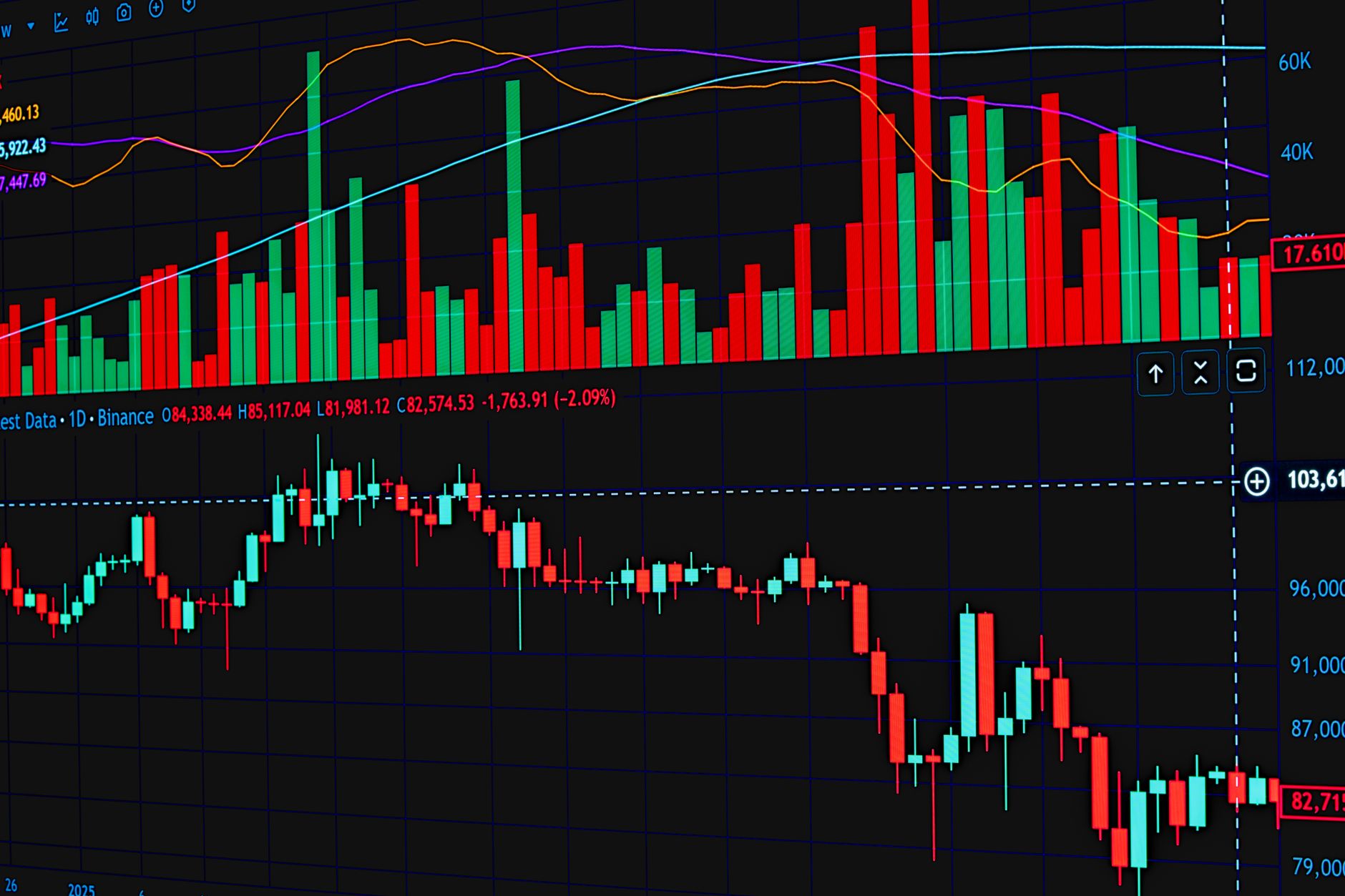
- Candlestick charts: Similar to bar charts but with visual bodies that make patterns easier to identify
Timeframe selection depends on your trading style. Scalpers might use 1-minute to 15-minute charts, day traders typically work with hourly charts, swing traders focus on daily charts, and long-term investors analyze weekly or monthly charts. Many successful traders use multiple timeframes simultaneously—a technique known as multiple timeframe analysis—to identify the primary trend on higher timeframes while timing entries on lower timeframes.
For cryptocurrency analysis, candlestick charts have become the industry standard due to their visual clarity. The table below summarizes common timeframes and their typical uses:
| Timeframe | Typical Use | Trading Style |
|---|---|---|
| 1-15 minutes | Entry/exit timing | Scalping |
| 1-4 hours | Intraday trading | Day trading |
| Daily | Medium-term positions | Swing trading |
| Weekly/Monthly | Long-term analysis | Position trading |
Support and Resistance Levels
Support and resistance represent the foundational building blocks of technical analysis. Support refers to price levels where buying interest is strong enough to prevent further decline, while resistance indicates levels where selling pressure halts upward movement. These levels form because traders remember where prices previously reversed and place orders accordingly.
In cryptocurrency markets, support and resistance levels often form around round numbers (psychological levels), previous highs and lows, and areas of high trading volume. A key concept is role reversal: when a resistance level is broken, it often becomes support on subsequent pullbacks, and vice versa.
Traders use several methods to identify support and resistance:
- Horizontal levels: Drawn at previous swing highs and lows
- Trendlines: Diagonal lines connecting successive highs (resistance) or lows (support)
- Moving averages: Dynamic support/resistance that changes with price
- Fibonacci retracements: Derived from mathematical ratios, often coinciding with psychological levels
For example, during Bitcoin's 2021 bull run, the $30,000 level served as strong support multiple times before eventually breaking in early 2022, after which it became resistance. Understanding these dynamics helps traders identify potential reversal zones and manage risk through strategic stop-loss placement.
Trend Analysis
Identifying the prevailing trend is arguably the most important aspect of technical analysis. Trends can be upward (bullish), downward (bearish), or sideways (consolidation). The classic saying "the trend is your friend" emphasizes trading in the direction of the primary trend rather than against it.
Trends exist across multiple timeframes simultaneously. A cryptocurrency might be in a long-term uptrend on weekly charts while experiencing a short-term downtrend on daily charts. Successful traders learn to distinguish between primary trends (lasting months to years), intermediate trends (weeks to months), and minor trends (days to weeks).
Several tools help identify and confirm trends:
- Trendlines: Connect successive higher lows in uptrends or lower highs in downtrends
- Moving averages: Rising moving averages indicate uptrends, falling ones suggest downtrends
- Average Directional Index (ADX): Quantifies trend strength regardless of direction
A practical example: Ethereum's 2020-2021 bull market showed a clear uptrend with successively higher highs and higher lows. The 50-day moving average provided dynamic support throughout most of this period, only breaking significantly during major corrections. Traders who recognized this trend early and bought pullbacks to the moving average captured substantial gains.
Chart Patterns
Chart patterns are recognizable formations that signal potential future price movements. They fall into two main categories: continuation patterns (suggesting the existing trend will resume) and reversal patterns (indicating a potential trend change).
Common continuation patterns include:
- Flags and pennants: Brief consolidations within strong trends
- Triangles: Symmetrical, ascending, or descending formations showing decreasing volatility
- Rectangles: Sideways trading ranges between parallel support and resistance
Reversal patterns include:
- Head and shoulders: Three-peak formation signaling trend reversal
- Double tops/bottoms: M-shaped or W-shaped patterns indicating exhaustion
- Rounding bottoms: Gradual transitions from bearish to bullish sentiment
In cryptocurrency markets, these patterns often form more quickly than in traditional markets due to higher volatility. The 2021 Bitcoin double top around $64,000 provided a classic example of a reversal pattern, preceding a significant bear market. Pattern recognition requires practice but becomes more intuitive with experience. For deeper exploration of specific patterns, see our guide to crypto chart patterns.
Technical Indicators
Technical indicators are mathematical calculations based on price and/or volume data. They help traders identify trends, momentum, volatility, and potential reversal points. Indicators fall into several categories:
Trend-following indicators help identify and confirm trends:
- Moving averages (simple, exponential)
- MACD (Moving Average Convergence Divergence)
- Parabolic SAR
Momentum indicators measure the speed of price movements:
- RSI (Relative Strength Index)
- Stochastic oscillator
- Williams %R
Volatility indicators quantify price fluctuations:
- Bollinger Bands
- Average True Range (ATR)
- Keltner Channels
Volume indicators analyze trading activity:
- On-balance volume
- Volume-weighted average price (VWAP)
- Chaikin Money Flow
No single indicator works perfectly in all market conditions. Successful traders typically combine 2-4 complementary indicators while avoiding indicator overload. For instance, a common approach uses moving averages to identify trend direction, RSI to gauge overbought/oversold conditions, and Bollinger Bands to assess volatility.
Volume Analysis
Volume—the number of coins or contracts traded during a given period—provides crucial confirmation for price movements. The principle "volume precedes price" suggests that changes in trading activity often foreshadow price changes. High volume during breakouts or breakdowns increases their validity, while low volume during such moves suggests potential false signals.
In cryptocurrency markets, volume analysis presents unique challenges and opportunities. Unlike traditional markets with centralized exchanges, crypto volume is distributed across numerous exchanges, some of which may report inflated or inaccurate numbers. However, several reliable metrics help assess genuine trading activity:
- Exchange-specific volume: Focus on reputable exchanges with audited volume
- On-chain metrics: Analyze blockchain transaction volume and active addresses
- Volume profile: Identify price levels with historically high trading activity
Volume patterns often reveal institutional versus retail participation. Sustained high volume during uptrends typically indicates strong institutional buying, while sharp volume spikes during declines may signal panic selling. The table below shows how volume interacts with price movements:
| Price Action | Volume Pattern | Typical Interpretation |
|---|---|---|
| Breakout above resistance | Increasing volume | Valid breakout, likely continuation |
| Breakout above resistance | Decreasing volume | Potential false breakout |
| Decline to support | Decreasing volume | Weak selling pressure, potential bounce |
| Decline through support | Increasing volume | Strong selling, likely further decline |
Japanese Candlestick Patterns
Japanese candlestick analysis, developed in 18th-century Japan for rice trading, has become an essential component of modern technical analysis. Individual candlesticks and multi-candle formations provide insights into market psychology and potential reversals.
Single candlestick patterns include:
- Doji: Open and close are nearly equal, indicating indecision
- Hammer: Small body with long lower wick, suggests potential bullish reversal after decline
- Shooting star: Small body with long upper wick, indicates potential bearish reversal after advance
Multi-candle patterns offer stronger signals:
- Engulfing patterns: A large candle completely "engulfs" the previous candle's range
- Morning/evening stars: Three-candle reversal patterns
- Three white soldiers/black crows: Strong continuation patterns
Candlestick patterns are most effective when combined with other technical tools and when they form at key support/resistance levels. For instance, a bullish engulfing pattern at a major support level with oversold RSI readings provides a much stronger buy signal than the same pattern in the middle of a trading range.
Risk Management in Technical Trading
Even the most sophisticated technical analysis cannot guarantee success without proper risk management. The cryptocurrency market's volatility makes position sizing and stop-loss placement particularly critical. Key risk management principles include:
- Risk per trade: Never risk more than 1-2% of your trading capital on a single trade
- Reward-to-risk ratio: Aim for at least 2:1 potential reward to risk
- Stop-loss placement: Base stops on technical levels rather than arbitrary percentages
- Position sizing: Adjust position size based on volatility and stop-loss distance
Technical analysis provides natural levels for stop-loss placement. Common approaches include placing stops:
- Below recent swing lows in uptrends
- Above recent swing highs in downtrends
- Outside chart pattern boundaries
- Beyond moving averages that define the trend
For example, if buying a breakout above resistance, a logical stop-loss would be placed below the breakout level or below the most recent swing low, whichever is closer. This approach ensures you're wrong about the trade if price returns to the previous range.
Combining Technical and Fundamental Analysis
While this guide focuses on technical analysis, the most successful cryptocurrency traders often combine technical and fundamental approaches. Fundamental analysis helps identify which cryptocurrencies have strong long-term prospects, while technical analysis determines optimal entry and exit timing.
Several integration strategies prove effective:
- Use fundamental analysis for asset selection, then technical analysis for timing entries
- Monitor on-chain metrics (fundamental) alongside price charts (technical)
- Pay attention to major news events that might override technical signals
- Adjust technical parameters based on a cryptocurrency's volatility characteristics
For instance, a trader might fundamentally believe in Ethereum's long-term potential due to its developer activity and adoption metrics, then use technical analysis to buy during corrections to key support levels. This hybrid approach leverages the strengths of both methodologies while mitigating their individual weaknesses.
Common Technical Analysis Mistakes
Even experienced traders fall into technical analysis pitfalls. Awareness of these common mistakes improves decision-making:
Over-optimization: Creating trading systems that work perfectly on historical data but fail in live markets. This "curve-fitting" problem is particularly dangerous in cryptocurrency markets, where conditions change rapidly.
Indicator overload: Using too many indicators that provide conflicting signals. Simplicity generally outperforms complexity in technical analysis.
Ignoring higher timeframes: Focusing exclusively on short-term charts while missing the broader trend context.
Disregarding volume: Trading breakouts without volume confirmation increases exposure to false signals.
Emotional trading: Abandoning technical signals due to fear or greed—the very emotions technical analysis aims to overcome.
Neglecting market context: Applying the same technical approaches regardless of overall market conditions (bull market vs. bear market vs. ranging market).
To avoid these mistakes, maintain trading journals, regularly review your methodology, and remain adaptable as market conditions evolve. Our guide to avoiding common trading mistakes provides additional insights.
Technical Analysis Tools and Platforms
Effective technical analysis requires appropriate tools. While basic charting is available on most cryptocurrency exchanges, serious traders typically use dedicated platforms offering advanced features:
Charting platforms:
- TradingView: Web-based platform with extensive indicators and social features
- Coinigy: Multi-exchange charting and trading
- CryptoWatch: Integrated with Kraken exchange
Trading terminals:
- MetaTrader 4/5: Popular platform with automated trading capabilities
- NinjaTrader: Advanced analysis and simulation features
On-chain analytics:
- Glassnode: Comprehensive blockchain metrics
- CoinMetrics: Institutional-grade crypto financial data
Mobile applications:
- TradingView mobile app
- Exchange-specific apps with basic charting
Most platforms offer free versions with basic functionality and premium tiers with advanced features. When selecting tools, consider your trading style, technical requirements, and budget. Many successful traders start with free tools before investing in premium platforms as their skills and capital grow.
Conclusion: Mastering Technical Analysis for Crypto Success
Technical analysis provides cryptocurrency traders with a systematic framework for navigating volatile markets. By studying price action, volume, and market psychology, traders can identify probabilities rather than certainties—a crucial distinction in unpredictable crypto markets.
This comprehensive guide has covered the essential components of technical analysis, from foundational concepts like support/resistance and trends to advanced techniques involving multiple indicators and timeframe analysis. Remember that technical analysis is both an art and a science, requiring both systematic study and practical experience.
The most successful technical traders develop consistent methodologies rather than chasing every new indicator or pattern. They understand that losses are inevitable and focus on risk management to preserve capital during inevitable drawdowns. They also remain adaptable, recognizing that no single approach works in all market conditions.
As you develop your technical analysis skills, continue your education with our specialized guides on crypto trading strategies, risk management techniques, and market psychology. The Crypto Dash provides the tools and insights you need to make data-driven investment decisions in the dynamic world of cryptocurrency trading.
Technical analysis won't guarantee profits, but when combined with sound risk management and continuous learning, it significantly improves your probability of long-term trading success. In the fast-moving cryptocurrency markets, this structured approach to decision-making can mean the difference between emotional reactions and strategic positions aligned with market realities.