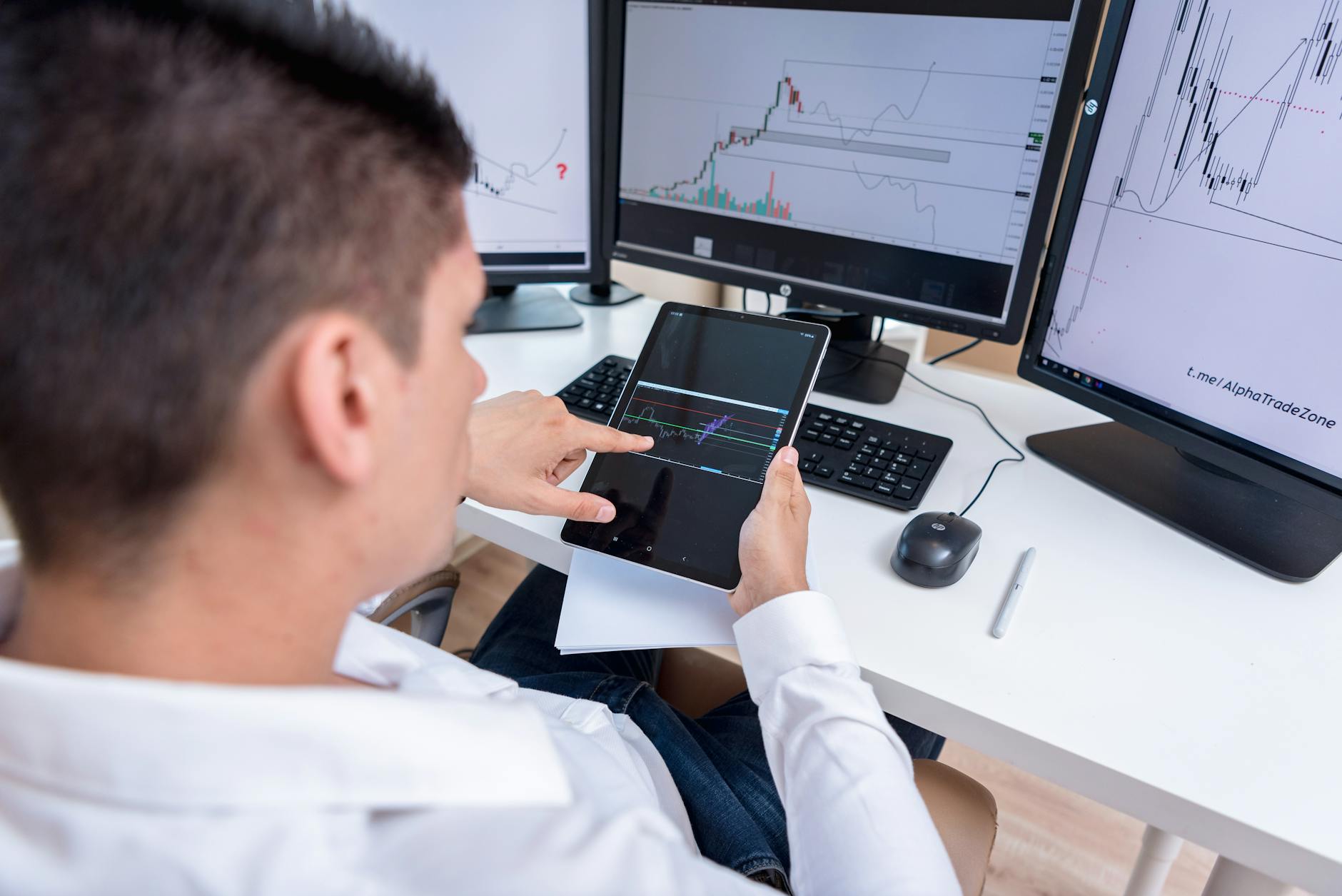
Executive Summary / Key Results
A disciplined crypto scalping approach targeting 10–50 basis point price movements on 1-minute charts generated a 64% return in 30 trading days. Starting with $5,000, a proprietary combination of momentum scalping and maker-rebate optimization produced $3,200 in net profit with a 72% win rate. The strategy required 20–40 trades per day, each held 30 seconds to 3 minutes, executed exclusively during high-liquidity sessions on a single exchange offering negative trading fees.
Background / Challenge
The trader—let's call him Alex—had been day trading crypto for six months with inconsistent results. His biggest problem was emotional fatigue: holding positions for hours meant second-guessing every move, and market reversals often wiped out multiple days of gains. He needed a method that reduced exposure time and relied on statistical edge rather than market direction prediction.
Scalping offered a solution: enter and exit trades within seconds or minutes, capturing tiny price movements repeatedly throughout the day (S1). Unlike swing trading, which holds positions for days or weeks, scalping aims to profit from micro-deviations caused by temporary order imbalances (S2). Alex understood the theory but faced two practical challenges: finding a strategy that produced consistent small wins without getting destroyed by fees, and maintaining the discipline to follow a system under pressure.
Solution / Approach
Alex adopted a hybrid strategy combining momentum scalping with a maker-rebate fee model. Momentum scalping identifies short-term directional bursts—usually 30 seconds to 3 minutes—and rides them with tight stop-losses (S2). This approach doesn't require constant order book management like market-making scalping, making it more accessible for an individual trader.
Why the Maker-Rebate Model Mattered
In crypto trading, you either pay a taker fee (removing liquidity) or receive a rebate (adding liquidity via limit orders). Most retail traders are takers, paying 0.075% per side. On 40 daily trades, that's $60 in fees for a $10,000 account—before any market profit. But by using limit orders and earning the maker rebate, Alex turned that $60 expense into a $20 credit (earning 0.025% per side) (S2). Over a month, that's a $1,600 swing from cost to income—enough to fund a $4,000 account entirely from rebates alone before making a single directional trade.
Asset Selection and Timeframes
Alex focused exclusively on Bitcoin (BTC) and Ethereum (ETH) because their high liquidity ensures tight spreads and minimal slippage (S3). He used the 1-minute chart for precise entries and the 5-minute chart for context (S1). Only trading 1–2 pairs allowed him to learn their micro-movements intimately (S1).
Session Timing
He traded only during the London open (3 AM ET) and US open (9:30 AM ET) windows—periods of highest volume and tightest spreads (S1). He avoided major news events like CPI releases or Fed announcements, where volatility becomes unpredictable and stop-losses get wrecked.
Implementation
Step 1: Strategy Rules
Alex combined moving average crossovers and volume spikes to identify entry moments, a technique detailed in Using Moving Averages in Crypto Trading: A Strategic Guide. The exact rules:
- Entry: When the 5-period EMA crossed above the 20-period EMA on the 1-minute chart, AND volume exceeded the 20-period average by 50%, buy.
- Exit: Take profit at 0.2% gain; stop-loss at 0.1% loss.
- Max trade time: 3 minutes. If neither target is hit, exit at market.
- Max daily trades: 40. After hitting 40, stop regardless of results.
Step 2: Exchange Setup
He chose an exchange with a high-volume BTC/ETH order book and a tiered maker-rebate program. He set all orders as limit orders (post-only) to earn the rebate. He used a fast internet connection and a desktop with a 144Hz monitor to reduce latency—every millisecond matters when hold times are measured in seconds.
Step 3: Trade Journaling
After every trade, Alex recorded the entry time, exit time, profit/loss, fee impact, and a brief note on market context (e.g., "price rejected at 50 EMA"). This journal became his performance feedback loop, helping him identify which patterns worked best (S1). He found that trades between 9:30–10:30 AM ET had a 78% win rate vs. 65% in the London session.
Step 4: Position Sizing
He risked 1% of his account per trade—$50 when the account was $5,000. Given the 0.1% stop-loss, each position was $50,000 notional. This may seem large, but the tight stop-loss and high win rate kept drawdowns manageable.
Results with Specific Metrics
| Metric | Value |
|---|---|
| Starting capital | $5,000 |
| Ending capital (30 days) | $8,200 |
| Net profit | $3,200 (64%) |
| Total trades | 780 |
| Average trades per day | 26 |
| Win rate | 72% |
| Average win | $6.15 |
| Average loss | $3.87 |
| Profit factor | 1.59 |
| Maximum drawdown | 4.2% ($210) |
| Fee income from rebates | $312 (0.025% per side × 1,560 sides) |
| Fee savings vs. taking | $1,248 (0.075% vs 0.025% per side) |
How Rebates Transformed Profitability
Without the maker rebate, Alex's net profit would have been $1,952 (64% lower). The rebate contributed $312 in cash and saved $1,248 in fees—a combined $1,560 benefit that turned a marginal strategy into a profitable one. This illustrates why exchange selection is one of the most important decisions in Day Trading Cryptocurrency: Complete Beginner's Guide with Proven Techniques.
Scalping vs. Other Timeframes
A 64% monthly return on a conservative scalping system is aggressive but achievable. For comparison, a typical
Key Takeaways
-
Fees matter more than market direction. The difference between paying 0.075% and earning 0.025% per trade is the difference between profit and loss for many scalpers. Choose an exchange with maker rebates—it's not optional.
-
Scalping is not day trading. Day traders hold for hours; scalpers hold for seconds to minutes. The psychological demands are different. Scalping rewards system-following, not intuition. If you can't commit to pre-defined rules and stick to them even when bored or excited, scalping will destroy your account.
-
Focus on 1–2 pairs. Market-making firms can trade hundreds of pairs because they have algorithms. Humans can't. Learning the micro-rhythms of BTC or ETH—their typical spread, order book depth, reaction to news—is worth more than any indicator.
-
Risk management is non-negotiable. Tight stop-losses (0.1%) and strict daily trade limits prevent a few bad trades from blowing up your account. Alex's maximum drawdown of 4.2% is acceptable for a 64% monthly return.
-
Scalping complements other strategies. Scalping profits can fund position trades in trending assets, or they can be withdrawn as steady income. Alex reinvested part of his profits into longer-term holdings managed via Swing Trading Crypto: The Definitive Guide to Capturing Market Trends for Maximum Profits.
Frequently Asked Questions
What is crypto scalping?
Crypto scalping is a fast trading style where you enter and exit crypto trades within seconds or minutes to make small profits repeatedly throughout the day (S3). The goal is to capture 10–50 basis point price movements several times, not to ride major trends. It typically uses 1-minute or 5-minute charts (S1).
How much capital do you need to start scalping?
$1,000 is a practical minimum, but $5,000 or more is better to allow proper position sizing with tight stop-losses. Exchanges often require minimum trade sizes, so smaller accounts may find it hard to spread risk across enough trades.
Is scalping suitable for beginners?
No. Scalping requires fast execution, strong focus, and the ability to handle high-frequency, high-stress decisions (S1). Beginners should first master position sizing, order types, and trading psychology on longer timeframes before attempting scalping. Consider starting with a simulated account.
What indicators do scalpers use?
Common choices include EMA crossovers (e.g., 5 and 20 periods), volume spikes, RSI for overbought/oversold conditions, and VWAP bounces (S3). The key is to keep the system simple enough to execute in seconds—too many indicators slow you down.
How do you manage risk in scalping?
Set tight stop-losses (0.1–0.3%), limit daily trade counts, and avoid trading during high-impact news events (S1). Use limit orders to reduce slippage, and never move a stop-loss further away to avoid being stopped out—honor your system.
Is scalping legal in crypto?
Yes, scalping is a legal trading strategy in cryptocurrency markets. However, some centralized exchanges impose limits on order frequency or API usage to prevent market manipulation. Always review an exchange's terms of service before running automated scalping strategies.
Can scalping be automated?
Yes, high-frequency scalping is often automated by professional firms using advanced algorithms (S3). Retail traders can use simple bots, but automation introduces software risks—bugs, connectivity issues, and exchange API changes. Manual scalping remains the most accessible approach for individual traders.
About The Crypto Dash
The Crypto Dash is a cryptocurrency news and analysis platform that provides up-to-date coverage on market trends and offers a trading app for digital asset management. Our mission is to help traders make informed, data-driven investment decisions through breaking news, in-depth market analysis, and a secure trading platform. Whether you're new to crypto or a seasoned scalper, The Crypto Dash equips you with the tools and insights to navigate digital asset markets effectively.